Direct answer
Buying a nitrogen cryosauna means buying into a supply chain. It needs a reliable local liquid-nitrogen supplier, compatible tanks, safe delivery access, ventilation, oxygen monitoring, operator procedures and service support. A lower equipment price can be eaten up by recurring gas, delivery, rental and staffing costs.
The safety stakes are real. An OSHA enforcement record documents a fatal oxygen-deficient atmosphere during liquid-nitrogen dispensing where ventilation and oxygen monitoring were inadequate. One incident doesn't define a universal room specification, but it is why a model-specific plan and qualified local review must come before opening.
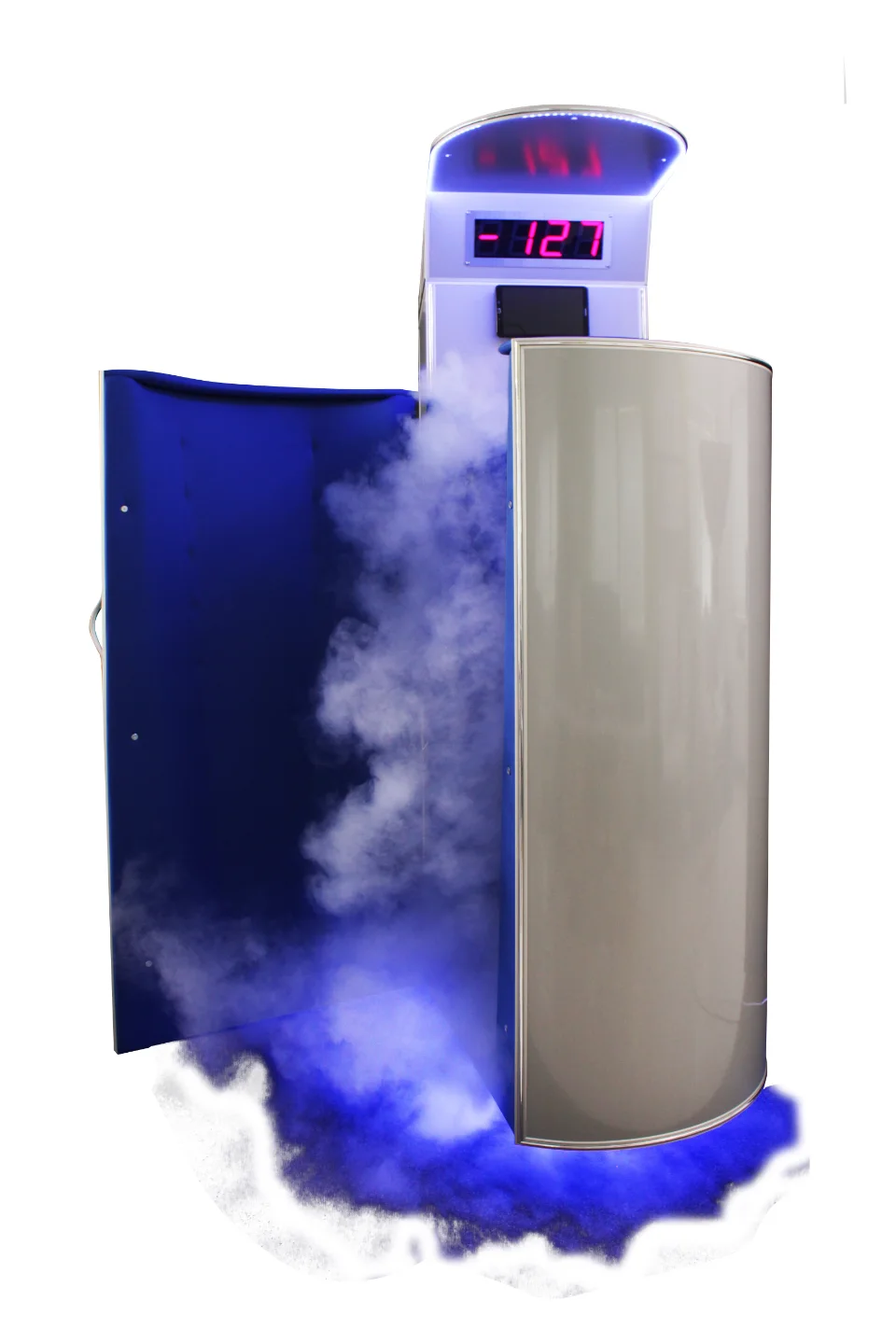
Historical product photo dated 2018, not a current offer, a model specification or an operating instruction. An open door and visible vapor do not establish a safe operating state.
Photo: Cryomed S.R.O., Wikimedia Commons source, CC BY-SA 4.0. Resized and converted to WebP; no content retouching. Derivatives are provided under the same license. No manufacturer endorsement is implied.

Current models to screen
| Model | Format | Captured consumption claim | Site evidence | Important unknown |
|---|---|---|---|---|
| Cryo Innovations XR | Open-top, one person | 2-3 liters per session | Ventilation and operator controls required | Exact circuit, footprint and current quote |
| CRYONiQ CRYO XC Plus | Open-top, one person | 5-8 liters pressurized or 4-7 liters non-pressurized | Forced ventilation, oxygen sensor and external exhaust guidance | Destination package and total delivered cost |
| Cryomed legacy PRO Ultra | Open-top, one person | Legacy sheet lists 4.05 liters for a 3-minute session and 2.87 liters precooling | Undated legacy sheet, not a current room approval | Exact model identity, revision and destination package |
| Current CryoMe Pro | Open-top, one person | Current page lists 4.05 liters for a 3-minute session and 2.87 liters precooling | Page and product-sheet dimensions disagree | Resolve current drawings, sensors and operator-screen version |
| Current CryoMe One Ultra | Open-top, one person | Current page lists 2.48 liters per session and 3.25 liters precooling | Separate model record | Operating assumptions, room plan and written package |
| CRYO Science Arctic Performance | Enclosed, one person; nitrogen heat exchange | Unknown | Supplier publishes room and access requirements for this model | Current manual, consumption, controls and warranty |
Prices and document versions to reconcile
The CRYONiQ US catalog, checked October 6, 2026, lists XC from USD 36,750 and XC Plus from USD 38,750. These are starting prices. Ask which tank system, controls, freight, training and installation responsibilities belong to the configuration you are quoted. A lower equipment line doesn't settle any of the supply questions below.
The current CryoMe Pro page and its product sheet, both checked October 6, disagree. The page shows 2.40 m height, four sensors and a 20-inch screen; the sheet shows 245 cm, five sensors and a 22-inch screen. Don't pick the convenient number for a room drawing - ask the supplier which revision is being offered. One Ultra is a separate model, and its lower consumption per session can't stand in for the Pro's figure in a cost estimate.
An enclosed cabin isn't proof of electric cooling. The Arctic Performance page describes nitrogen heat exchange with its own facility needs, so confirm the cooling medium from the model documents, not the look of the enclosure. Automation or a lift that sets the user at face height doesn't mean the unit can run without trained supervision either.
Supply readiness checklist
- Obtain two local supplier quotes with product grade, delivered price and fees.
- Confirm tank type, rental, deposits, delivery minimum and emergency availability.
- Map the delivery route and full tank weight.
- Price normal evaporation and unused inventory.
- Give the current manufacturer plan to local safety and building professionals.
- Record ventilation, monitoring, exhaust and training responsibilities.
- Model gas cost from documented liters per completed session.
Normalize supplier quotes
Ask every gas supplier for the same fields, so the quotes can be compared line by line:
- Delivered liquid price and product grade
- Tank or dewar type and usable capacity
- Rental, deposit and contract length
- Delivery charge, fuel surcharge and minimum order
- Scheduled lead time and emergency delivery terms
- Site assessment and access or storage conditions before the first delivery
Take expected consumption from the equipment manual; liters-per-session figures don't transfer between models. Add evaporation, venting, partly used tanks and idle periods as separate inputs. Divide total monthly gas and tank cost by completed sessions, and run low, base and high volume cases. The nitrogen cost guide has a calculator for this.
Operating questions
- Which operator actions are required before, during and after each session?
- Which oxygen monitoring, alarms, ventilation and exhaust components are specified?
- Who owns inspection and maintenance of tanks, hoses and connections?
- Can a full tank move safely from the delivery point to storage?
- What happens when a delivery is missed or consumption exceeds plan?
- Which consumables and protective items are included with the equipment?
- Which local authority, insurer or landlord must approve the setup?
Removal criteria
Drop a model when the local gas supplier can't support its tank system, the delivery route is unresolved, the room plan hasn't had qualified review, no service provider is named, or the quote leaves out significant operating dependencies.
Sources and limitations
The October 6, 2026 document review covered the CRYONiQ brochure, the XR Thermal Edition brochure and the Cryomed PRO Ultra sheet, along with the XR consumption claim, the CRYONiQ US catalog, the current CryoMe pages and sheet, and the CRYO Science Arctic page. Each document describes specific variants: the XR brochure is not evidence for the electric Kiosk, and the legacy Cryomed PRO Ultra sheet doesn't establish current CryoMe specifications. The PDFs are undated and their consumption figures are supplier statements, so budget from a current model manual and written quote. Unchanged older fields keep their recorded check dates.
The safety boundary relies on the cited OSHA enforcement record. Local rules and supplier requirements govern the final installation, and this page doesn't replace a site risk assessment.